
Violence against rescue workers
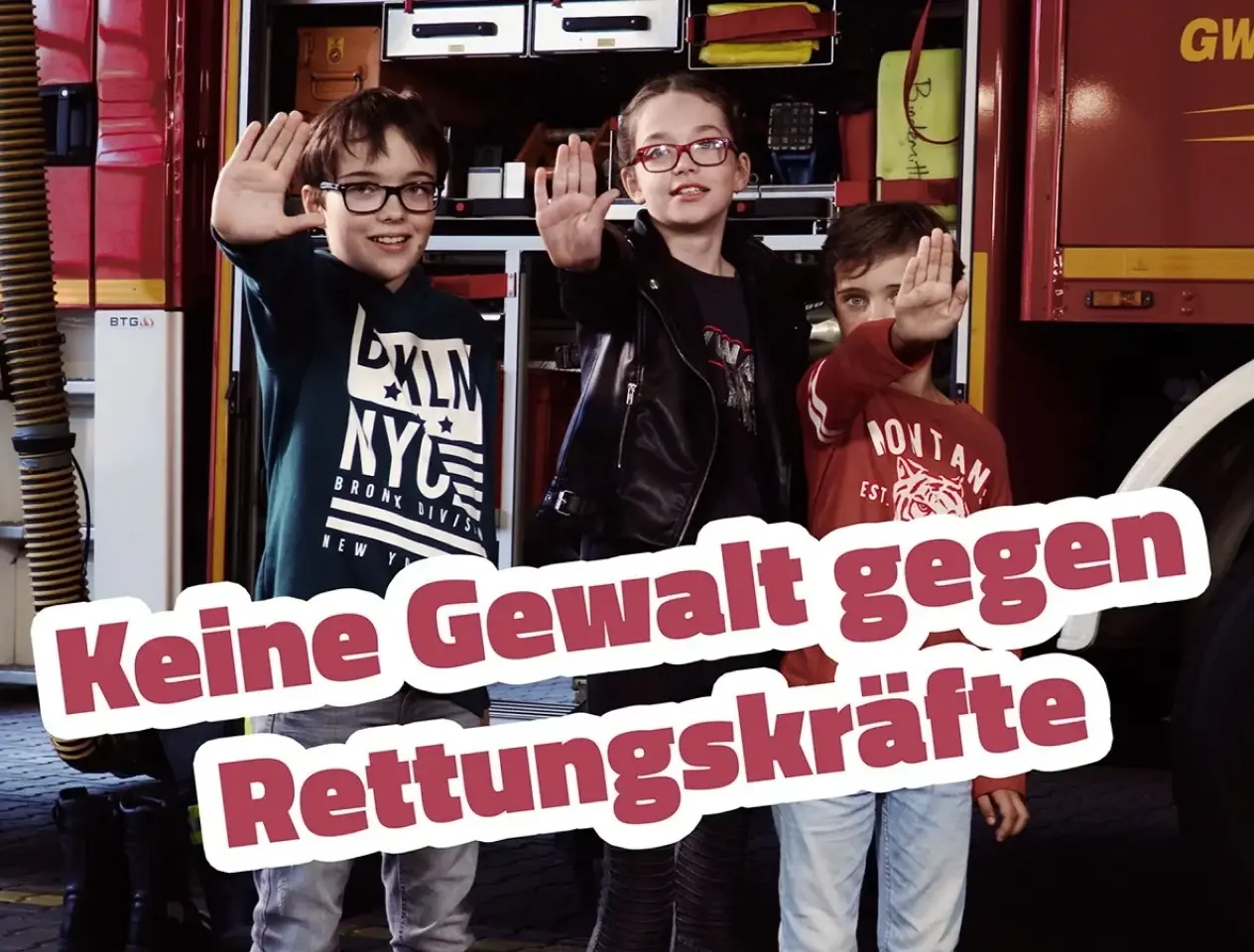
Will our helpers soon need help themselves?
Sven Puchert is an active member of the volunteer fire brigade and is highly committed to helping other people. During his last deployment last month, things went differently than usual – and it was deeply unsettling for all the forces involved: during a routine rescue operation, one lane had to be closed during rush hour. This led to a very slow flow of traffic and long tailbacks. Apparently too much for one of the commuters: he got out of his car and vented his anger, first verbally and then physically and aggressively. He ripped the hose from an assistant’s hand, pushed him and he landed on the kerb, completely perplexed. The colleagues who rushed to help were able to prevent worse. „We were already busy clearing up – suddenly the man was standing in the middle of us and just went berserk,“ says Sven Puchert. „We were so surprised that it took us a few seconds to even realise the situation. We are simply not prepared for these conflict situations! Then we acted intuitively and freed our colleague from the situation and isolated the attacker. We had a de-escalating effect on him and were able to get him to let us finish our work undisturbed.“
No more isolated cases
A scene that unfortunately happens like this – or similar – every day throughout Germany. And it doesn’t always go so smoothly for everyone involved. Violence against rescue workers has been on the rise for years. This not only concerns the helpers themselves – but also the courts and even scientists. Where does this aggression against people who help others, sometimes at the risk of their own lives, come from?
Prof Dr Thomas Feltes, criminologist at Ruhr University in Bochum, has studied the topic intensively over a long period of time in recent years, researching and comparing attacks on paramedics, police officers and firefighters. In 2017, a study was commissioned by Unfallkasse NRW, the Ministry of the Interior NRW, the Ministry of Labour, Health and Social Affairs NRW and the komba trade union nrw to collect and analyse data on violence against medical rescue service personnel. A total of 4500 emergency services personnel from NRW took part in the survey over a period of two months. The results were presented at a closing event in February 2018.
How often does violence occur?
Of the emergency and rescue services surveyed, almost 2/3, i.e. 64 per cent, said they had been victims of violence within the last 12 months.
Where is there more violence?
Rescue operations are particularly dangerous in large cities: in cities with more than half a million inhabitants, attacks on helpers are twice as common as in smaller cities. City centre areas are particularly affected by escalations.
When do assaults occur more frequently?
Over 60 per cent of all attacks against emergency services personnel take place at night, i.e. between 6pm and 5am.
Who are the perpetrators?
The people who commit assaults are mostly male (85% for physical and 92% for verbal violence) and are often under 30 years old. In the case of non-verbal violence, there is practically a one-third split: In 34 per cent of cases, it is the patients or victims themselves, 20 per cent their relatives – and 30 per cent uninvolved passers-by and onlookers. Verbal violence is perpetrated 42 per cent by patients/affected persons, 24 per cent by relatives and 19 per cent by passers-by or onlookers. If it comes to physical violence, almost 75 per cent of it comes from patients or those affected.
Alcohol plays a major role in assaults overall.
What types of assault are there?
The assaults involve verbal, non-verbal and physical violence: from insults, bully words and threats of violence and clear gestures such as the outstretched middle finger to actual physical attacks, the range of disruptions and attacks from the attackers is very wide. Sabotage or direct intervention in rescue operations are also becoming increasingly common.
Rescue workers are most frequently affected by violence: almost 94 per cent of this group of participants have been victims of violence, while firefighters are affected less frequently at 42 per cent.
Effects and consequences of ongoing assaults
As emergency service employees have reported more and more frequently about disturbances, obstructions and violent assaults in recent years, media coverage has also increased, bringing the problem more and more into the public eye. Politicians are now also reacting: the state parliaments are also dealing intensively with the issue in the interior committees, which in turn has led to a series of amendments to the law: Sections 113 and 114 of the German Criminal Code (resistance against law enforcement officers and against persons who are equivalent to law enforcement officers) have been extended and tightened.
The psychological effects on the emergency services are also manifold: fear of new missions, insecurity and mistrust are increasingly common side effects of daily business – and yet almost 61 per cent of those surveyed still feel safe when on duty.
When interpreting the results, it must be borne in mind that the emergency services complete several hundred missions per year. This means that violent assaults are still a rather rare occurrence – even if the number of unreported cases is certainly higher and assaults are rarely reported: For example, around 80 per cent of emergency personnel affected by verbal and non-verbal violence stated that they did not report the last assault on their person.
Training also plays an important role for emergency services, both now and even more so in the future. The Safetytour offers you the right workshop on this topic.
Sources:
„Gewalt gegen Einsatzkräfte der Feuerwehren und Rettungsdienste in NRW“, Ruhr University Bochum, Chair of Criminology, Criminal Policy and Police Science, Professor Dr Thomas Feltes.