
Impregnation of outer fabrics
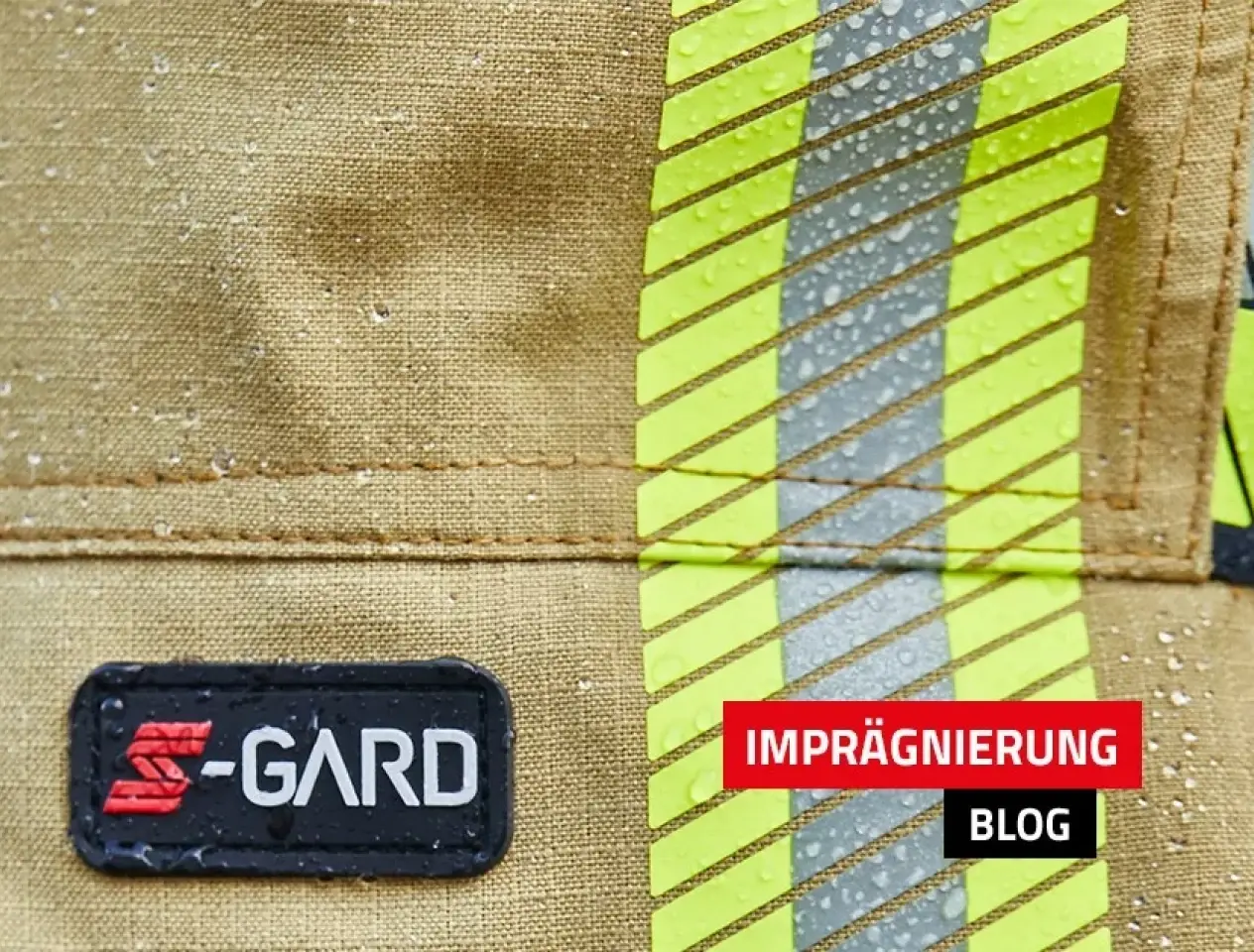
Impregnation of outer fabrics
Why do I need this?
What is this?
Status today
What’s coming in the future?
The outer fabrics of outerwear today have an impregnation that is oil, water and chemical repellent. Here in Europe, fluorocarbon (FC) chemistry is mainly used for impregnation.
Overview
Recently, topics have come up more and more frequently:
- Ban on C8
- Long-term impregnation with C6
- non-FC finishes
But what are all these issues about?
First of all, you need to understand why protective clothing is impregnated in the first place. Modern outerwear usually has a membrane that prevents water and chemicals from penetrating the inside of the suit. However, this is not enough to provide adequate protection for firefighters. The outer fabric must also be prevented from soaking up water, as a wet suit is not only heavier, but also transports heat energy into the suit up to 23 times faster than a dry suit. Furthermore, an appropriate treatment of the outer fabric should prevent chemicals, oils or other flammable liquids from penetrating the outer fabric, which could cause a non-flammable suit to burn due to the chemicals and thus become a hazard for the wearer. As impregnation is a subsequent enrichment of the fabric, it is essential that the enrichment is permanent. The protection should last as long as possible. Nowadays, this is usually measured in the number of wash cycles. A good impregnation lasts up to 40 wash cycles before the repellent properties have significantly diminished.
Impregnation is therefore essential for the outer fabric of outerwear.
But what is FC impregnation anyway?
During FC impregnation, perfluorocarbons PFCs are bonded to the outer fabric. PFCs are (source Wikipedia) carbon compounds that are completely substituted with fluorine (i.e. they no longer contain any hydrogen atoms). They belong to the group of hydrofluorocarbons (HFCs), fluorinated derivatives of hydrocarbons.
The positive properties of PFCs: They have permanent oil and water-repellent (amphiphobic) properties. A material impregnated with them therefore provides perfect protection against moisture and chemicals, permanently.
The negative properties: the longer the chain of the PFCs (i.e. the more carbon atoms (C) they have, the better the protective properties, but the worse they are degraded in the environment. They accumulate in nature and also in the human body. In extreme cases, this can lead to cancer and other diseases.
For this reason, the long-chain versions (C8) are now banned and may no longer be used in protective clothing from April this year.
Status today
Today, outer fabrics here in Europe are finished with C6 chemistry. The method of application has been improved by the industry in such a way that C6 chemistry can now withstand up to 40 washes.
But haven’t we just realised that PFCs are not healthy? And in such a way that C8 has already been banned? So why do we have C6 (or possibly new: C4) on our outer fabrics?
In the USA, protective clothing for firefighters may no longer be treated with PFC impregnation. A decision has been made here: it will be banned and the industry will solve the problem. They should find a chemical that works as well as PFCs, but without the harmful disadvantages. So-called non-PFC solutions are now available in the USA. These are impregnations that do not contain PFCs. The disadvantage of these solutions (as of today) is that they provide good protection against water, but are not as durable as C6 chemistry, for example, and therefore have to be reapplied more quickly. This in turn has a negative impact on the environment. And they do not protect against oils and other chemicals.
Here in Europe, experts take a different view of the situation. To exaggerate the situation: if police officers were forbidden to use Kevlar in bulletproof vests, so that they had to use cotton, for example, they would be wearing „healthy“ waistcoats, but the protection they were actually aiming for would no longer be provided. Or to put it another way: firefighters not only need an outer fabric that provides (limited) protection against moisture (water), they also need full protection, which (as things stand today) can only be achieved with PFCs.
The future
Things will certainly look different in the future. Ultimately, we live in a market economy and the market determines what is made available to us. As C8 chemicals are already banned and other PFCs will be used less frequently in the future, the availability of PFCs will become increasingly scarce. The first major chemical companies have already stopped production. This will inevitably lead to alternatives being sought and, in all probability, found. As soon as the new effective chemicals are available, we will also say goodbye to PFCs as an impregnation for outer fabrics in Europe.
To date, however, C6 chemistry is (still) the best solution for our area of application.