
Electronics in protective clothing
Why has it still not caught on today?
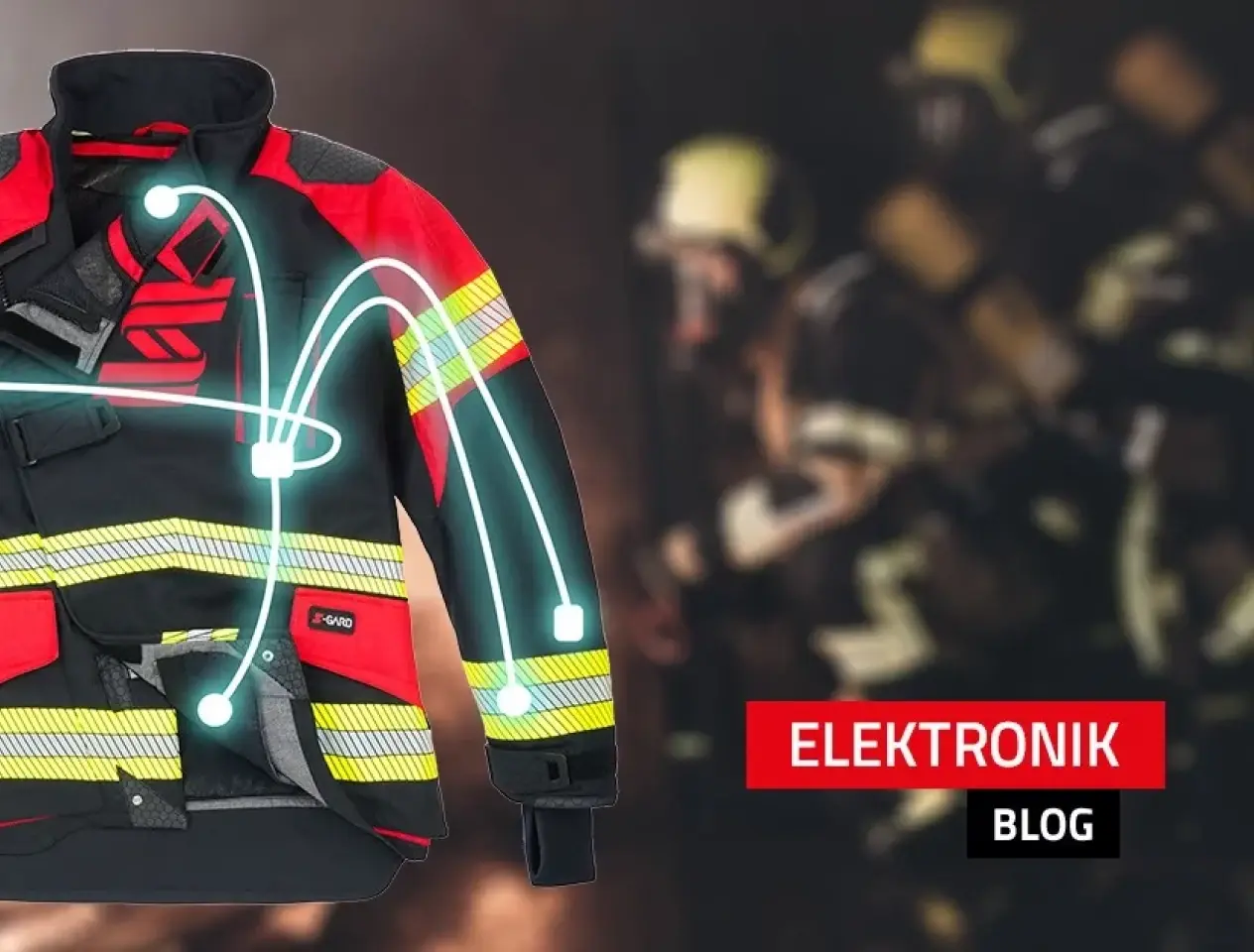
Electronics in protective clothing… Who hasn’t thought about it? Clothing that protects the wearer even better with electronic components. Simply super.
Especially with PPE category III, i.e. the category of PPE designed to protect the wearer from fatal hazards, the idea is obvious: the protection can’t be good enough. And so electronics must inevitably be integrated, right? And the following solutions in particular all make sense:
- Electronics that significantly improve visibility, e.g. through active lighting
- Electronics that cool the wearer in ambient temperatures that are dangerous for humans
- Electronics that monitor the wearer’s vital functions and raise the alarm before it is too late
- Electronics that support the wearer when working with motor skills
- Electronics that help to localise the wearer in unfamiliar terrain
- Electronics that help to interact with machines in the environment.
Unfortunately, all this still sounds like science fiction. But why? When it makes so much sense?
And – haven’t electronics already been integrated into clothing for many years? In the entertainment industry, for example? Can’t smartphones already be controlled with jackets? Aren’t there already shirts that play animations or sounds when paired with a smartphone? And also shirts that help to monitor bodily functions?
And aren’t there projects in Europe every year that are subsidised with a lot of money to advance electronics in protective clothing?
Yes, there are already electronics in clothing. And yes, there are research projects. And yet there are still no electronics in firefighters‘ clothing.
The reasons are complex. We want to categorise them into three categories here:
- Realisation
- Washing
- Legal
Realisation
There are already ideas, studies and prototypes for all 6 categories of electronics that we have listed above. But only a few of them have made it past the prototype stage.
A common problem is the power supply. How can you ensure that there is always sufficient power supply? Because unlike shirts that you wear just for fun, PPE must always work. In addition, the protective clothing itself should not get in the way. But a battery and cables are often a hindrance. Today, there are solutions in which small battery packs are installed in such a way that they hardly get in the way. Inductive charging also eliminates the need for connections.
The batteries are encapsulated in such a way that they can also be washed. And cables that might get in the way are replaced by fabrics that are electrically conductive. So we’re getting closer and closer to the solution, aren’t we?
Washing
Protective clothing, especially protective clothing for firefighters, must be washed so that it does not itself become a hazard due to contamination. In order for a washing process to achieve a good result, various interdependent influences are necessary. These influences are
- Mechanics
- temperature
- chemistry
- Time
The interplay of these factors is called the Sinner’s circle. You can easily recognise the interplay: if I want something to get clean faster, I have to use more temperature or detergent, etc..
Professional laundries like to work at 60°C and above. Of course, there are also chemicals, mechanics and time. The catch is that the fabrics, which are electrically conductive, only work well in the long term if they are washed at a maximum of 40°C, or even lower. More chemistry and mechanics would then be the logical solution, as time alone does not help with washing. However, the solutions developed are also sensitive if too much chemical or mechanical action is used. This means that there have already been partial successes, but there are still no solutions to ensure that washing and electronics work together permanently. And PPE should not only work when new, but also in the long term.
While electronics and washing processes are gradually being harmonised with each other, the following problem is to be solved in parallel.
Legal basis
Nowadays, there is no set of rules that describes how protective clothing with electronics should work. Procurers who want to buy such new solutions so that the industry can further develop and perfect them are therefore entering a legally uncertain grey area. What can I give my employees without running the risk of something happening?
In the meantime, the first standards committees have been set up to deal with precisely this issue. The pros and cons of the new technologies are being weighed up and attempts are being made to involve the various parties. For example, the professional scrubbers and the electronics manufacturers. There will certainly soon be standards that describe such state-of-the-art and useful protective clothing. And certainly also soon working environments that will only allow the new clothing.
However, this does not yet resolve the personal rights of the wearer. Because these must always be taken into account: e.g. in the case of technology that monitors bodily functions. A wearer must first of all consent to such monitoring. But demanding consent to monitoring is not permitted in this country. So it’s a dilemma. And it is not always so clear that the wearer simply agrees to it. What is clear is that the electronics are there to better protect the wearer in a life-threatening environment. And it can be good to monitor vital functions, especially when the body has to perform at maximum capacity. Imagine if such monitoring could protect the wearer from collapsing (see recent incidents in professional sport, for example). The disadvantage, however, is that the employer’s software knows a lot about the wearer. And this could influence the assessment of the wearer and their development. For example, a wearer could lose their job because the software’s algorithms determine that they should no longer be used for a particular job.
Conclusion
Electronics in protective clothing will offer many advantages in the future. It will come. 100%.
But until these electronics can protect us in our day-to-day work, the permanent implementation, care and legal background still need to be resolved. In any case, we are excited to see when the time comes. We at S-GARD support these developments through active work in standardisation committees and participation in numerous research projects, such as the current Paktex project.