
What happens to me and my PPE after use?
What happens to me and my PPE after use?
The alarm goes off: car on fire on the motorway. I’m in the attack squad. I kit myself out on the approach. As always, the fire bonnet is part of the kit – after all, I want to protect my skin completely. And not just against heat and, in the worst case, flames. We’ve recently started using fire bonnets with a „particle barrier“, which also protects me directly against potentially harmful substances. And that’s important! And why is that important to me, and why should it be important to you?
I’m sure you too are familiar with buzzwords such as „fire cancer“ or have read reports about sick comrades and have been sensitised to the importance of hygiene during an operation. But is hygiene only important during an operation? What happens to your turnout gear, fire bonnet, turnout gloves, firefighter helmet and turnout boots after your deployment? Do we all adhere to a golden rule that has been with us since basic training, namely „avoid contamination“?
Substances hazardous to health
Hazardous substances are released during every fire. If I come into contact with fire smoke and/or soot, I have become contaminated. It is now more important than ever to pay attention to hygiene. After all, I not only want to protect myself against harmful substances, but also my colleagues.
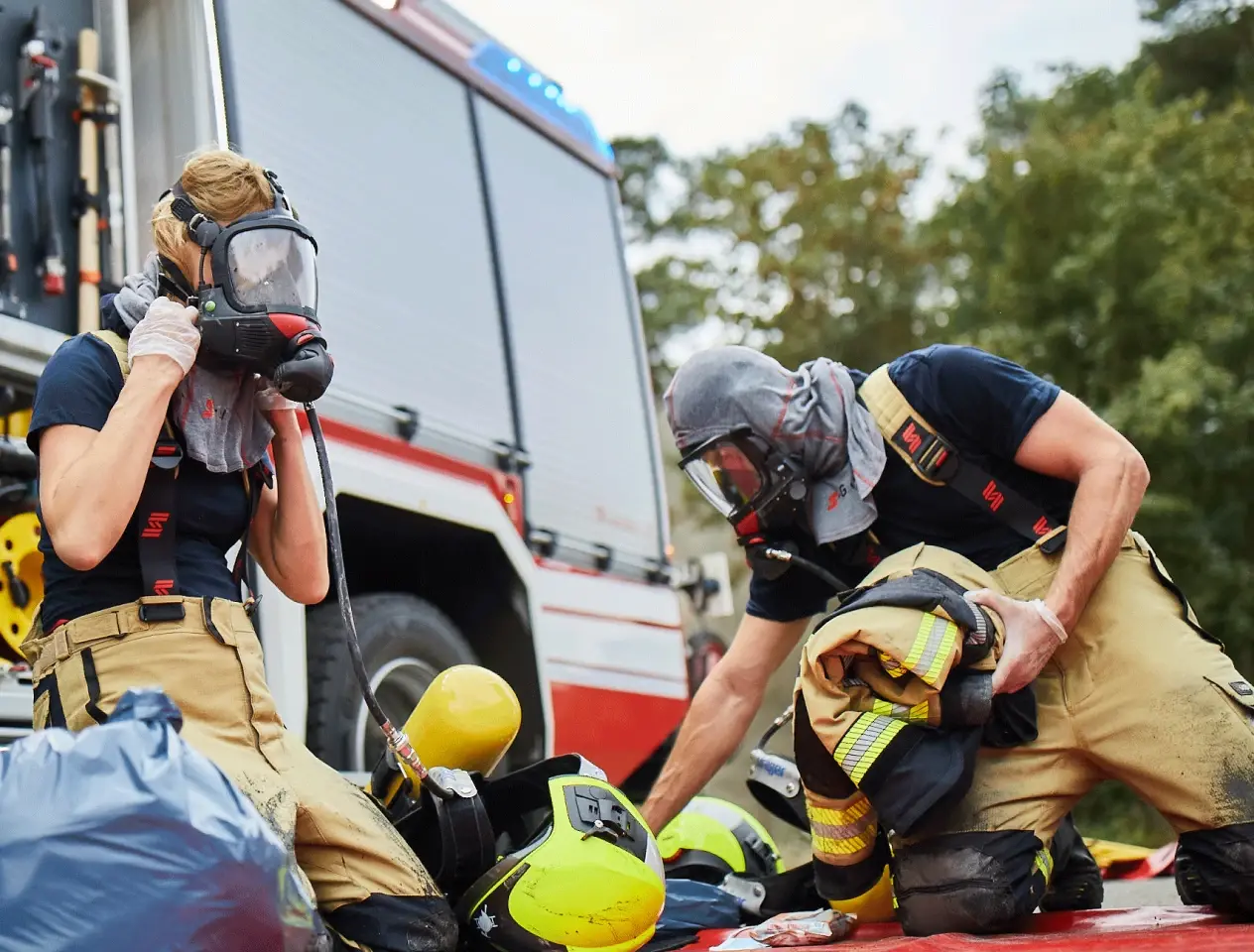
Burning plastics, rubber and fuels caused a lot of smoke and soot on the motorway during our deployment. My squad member and I were right in the middle of it instead of just being there. And that’s how we looked afterwards. There was a time when we would have patted ourselves on the back and driven back to our vehicle as filthy as we were. Without wasting a thought on hygiene or what we were doing with our behaviour. At the station, we would have given our breathing apparatus and masks to the breathing apparatus workshop. After all, they have to be cleaned and checked, which is the right thing to do. We would then have hung our PPE in the locker for the next deployment. Find the mistake. To be honest, this or something similar has happened in many places. In the worst-case scenario, it may still be happening here and there today. Unfortunately…
Dirt track
Back then, I left a „trail of dirt“ from the scene of the incident to the vehicle to the police station and changing room and back to my home. When I think about it today, I shudder. I not only endangered myself, but also my comrades and even my family through my behaviour.
What do I do differently today? That’s very easy to answer: I pay attention to hygiene. And not just for myself, but also for my comrades.
If I get contaminated at a fire today, I take off my PPE at the scene and pack it in an airtight container. This ensures that the smoke gases or particles released from the PPE do not lead to further contamination. I can then use the hygiene board on our HLF to wash my hands quickly and easily, for example. I’m well equipped with a tracksuit and Crocs as spare clothing, which I carry on the HLF. So I can make my way to the station without a guilty conscience. It’s as simple as that.
But my behaviour at the station has also changed. I don’t just hand in my breathing apparatus and mask at the respiratory protection workshop. I drop off my contaminated PPE in a specially labelled bin and fill out a form. One of my comrades then takes care of the next steps.
A laundry specially designed for firefighters collects the contaminated PPE promptly and prepares it properly and professionally. Simply washing is not enough. The protective clothing must not only be clean, but also fully functional. My protective clothing has to provide me with the necessary protection for my next deployment. That’s why countless parameters have to be taken into account during reprocessing. My firefighting boots and helmet also need attention. After all, they have also been contaminated during the operation.
Anyone who has ever dealt with the subject and is honest with themselves has to admit one thing: The refurbishment of PPE is so costly that it is very difficult, if not impossible, for a fire service to implement. And I’m not just talking about the financial resources that would have to be raised, but also the manpower and time involved.
What applies to my PPE also applies to me to some extent: I still have to wash myself. The finest particles that have been deposited on my skin during and after the operation have to be removed. Due to my physical work on the job, my skin pores are wide open so that harmful substances can easily penetrate my body. That’s why I take a cold shower at the station to rinse off as much of the superficial dirt as possible. Only then do I turn up the temperature and use a suitable shower gel. Now I can get dressed with a clear conscience and don’t have to worry about „spreading contamination“.
Each of us, including you, can help to ensure that important hygiene measures are implemented with little effort. If the fire brigade then takes care of the comprehensive reprocessing of PPE, it’s done. Like many things in our society, this all works best when we „live“ the topic.
Set a good example and encourage your comrades to do the same:
- Remove contaminated PPE after an operation
- Your own initial hygiene measures at the incident site
- Reprocess contaminated PPE properly and professionally
- Own hygiene at the station
With this in mind: Always come out of an operation in good health! And stay healthy afterwards by observing and implementing hygiene measures